This article was authored by Paolo Mercado, Lead Policy Expert for the Philippine National Design Policy Founder of the Creative Economy Council of the Philippines.
What if a country’s future could be shaped not just by policies or programs—but by imagination? By the ingenuity of its people, by its creative soul, by design? The Philippines is daring to answer this question through a bold and visionary move: the launch of its first ever National Design Policy. It’s more than a roadmap. It’s a manifesto. A call to action. A dream of a nation transformed—where design is not an afterthought, but a driving force behind economic progress, cultural pride, and social equity.
A Nation Rethinking Its Future—By Design
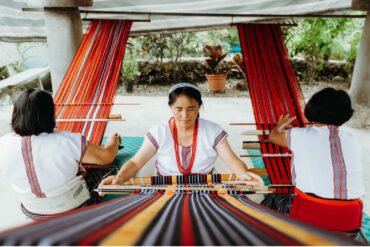
Design in the Philippines has always been present. You see it in the intricate weave of handwoven textiles, in the curve of a bamboo chair, in the bright colored jeepneys rumbling through city streets. But until now, design has rarely been recognized as a strategic tool for nation building. That’s what this new policy sets out to change.
Crafted by the Design Center of the Philippines and anchored in the landmark Design Counts study of 2023—the first mapping of the Philippines’ national design economy—the policy paints a clear picture: design already contributes over US $21 billion to the Philippine economy, representing 6.6% of the country’s Gross Value Added, and supports 705,000 jobs. But its potential is far greater.
The National Design Policy envisions a future where design is woven into every fibre of the Filipino way of life—from government programs to grassroots innovation, from classrooms to community centres, from local businesses to global trade fairs. This is because according to Rhea Matute, Executive Director of the Design Center of the Philippines:
“Design is a core capability and a problem-solving tool for the 21st century. Design enables effective innovation and aspirationally creates products, services, technologies and governance that lead and change the world. Design is also a driver of growth, exports, and jobs in a high-skilled, high-productivity economy. It transforms industries with a comparative advantage into those with a competitive advantage, creating industries of the future that are sustainable, inclusive, and anti-fragile.”
Designing with Filipino Value
The Philippines’ new design vision starts from the very soul of every Filipino. The policy is rooted in Filipino values that give it a distinct heartbeat. Kapwa is the core Filipino value of shared identity, and is the cornerstone of a humanity-centered design ethos that considers not just the needs of the individual, but of the community and society that we all coexist in.
Anchored on this core value are other Filipino values that define our design culture:
Malasakit, May Puso—or the compassion and passion that drives designers to solve real world problems; Malikhain, Madiskarte—or the creativity and ingenuity in the face of scarcity; Mabusisi, Mahusay—or the meticulous attention to detail and a passion for excellence. These values reflect our belief that design isn’t just for decoration. Design should be for transformation. Filipino designers should strive to make the world a better place with both head and heart fully engaged.
Vision and Mission: A Nation Transformed by Design
The Vision of the National Design Policy of the Philippines is a bold one: We ambition to unleash the Transformative Power of Design in the Philippines, cultivating a future where Filipino innovations flourish, global impact is realized, social transformation is enabled, and future generations are empowered to create a brighter tomorrow.
Its Mission is to create a transformative impact in four key areas:
- Design Sector – Develop world class Philippine design talent, businesses, and original ideas that together will establish the country as a globally recognized design powerhouse.
- Economy – Accelerate nationwide economic development by using design as a business accelerator, driving product and systems innovation, and increasing our nation’s intellectual property capital and global innovation ranking.
- Society– Harness the transformational power of design to improve lives of all Filipinos through design-led social innovation and humanity-centred public policy.
- Culture – Promote, preserve, and progress a unique Philippine Design Culture and Identity—one that honours heritage while shaping a vibrant future.
Design for All, Not Just the Few
At its core, the policy dares to challenge the view that good design is seen as a luxury, reserved only for the wealthy who can afford expensive designer goods and go to well-designed places. In the Philippines unfortunately, public infrastructure is often plagued by “design fails” where user needs are ignored in the development process.
This policy wants to flip that script. It declares that good design should be a right, not a privilege. That every Filipino—whether a child in the provinces or a student in the city—deserves products, services, spaces, and systems that uplift, empower, and reflect their dignity.
5 Priorities and 10 Actions to Ignite a Movement
What makes the National Design Policy of the Philippines truly exciting is how it moves from vision to action. It lays out a five-year plan (2025–2030) with ten bold strategic actions across five priority areas, each designed to embed design thinking and practice into the fabric of Filipino society. These are all summarized in the table below:
Measuring Not Just Progress—but Maturity
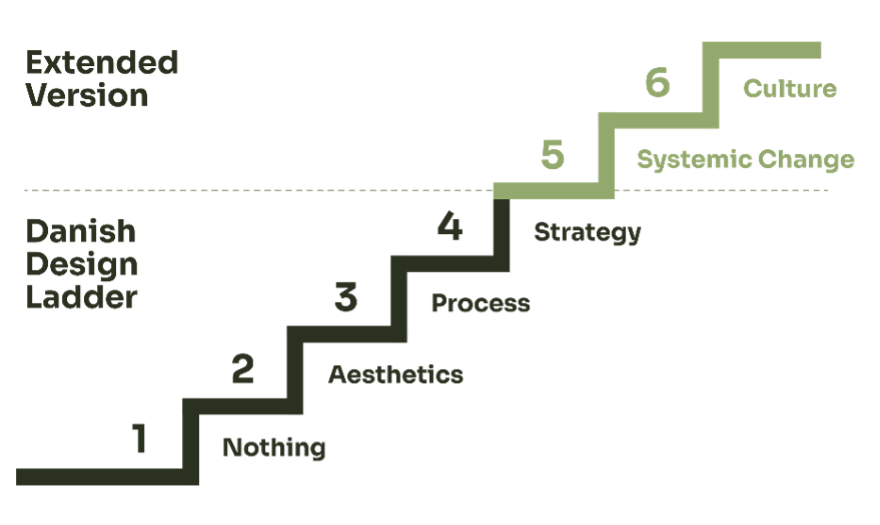
Many countries have adopted the Danish Design Ladder as a method to evaluate the adoption of design primarily in the business sector. For the Philippines’ National Design Policy, it wishes to adopt the Extended Design Ladder introduced by Bryan Hoedemaeckers and Dr. Lauren Tan in 2016 as its national measurement tool.
This expanded model will track how deeply design is embedded, not just in business but also in government, from basic aesthetics to full-scale cultural transformation.
“To use design as an aesthetic tool is to limit its potential—we use design as a strategic tool, wielding it to expand our imagination and create open pathways where there had been none”, underscored Mylene Abiva, Private Sector Co-Chairperson of the Philippines’ Design Advisory Council.
The goal is to conduct a national design adoption audit every 5 years.
An Invitation to the World
The Philippines is not doing this alone. The policy is a signal to the global design community: Come collaborate. Come co-create. Come be part of this journey.
Thus, the first key actions for the policy’s implementation include the launch of the Year of Philippine Design starting this year and the submission of the Philippines’ bid to host the World Design Congress in 2027. Philippine President Ferdinand Marcos Jr. said it best:
“Let us embrace the principles of innovation, of collaboration, and determination as we embark on this journey toward a future where Philippine design leads the way to economic prosperity, environmental stewardship, social equity and unity.”
Designing a Nation’s Destiny
The First National Design Policy of the Philippines is a rare and radical document. It refuses to separate creativity from policy, culture from commerce, or aesthetics from impact. It believes in design as destiny. It believes that in every Filipino lies a designer, and in every design lies the power to shape a more resilient, inclusive, and inspiring world.
This isn’t just a policy to read. It’s a future to build — together.
The Design Center of the Philippines is the national agency championing design as a catalyst for innovation, economic growth, and cultural preservation. As the lead architect of the National Design Policy, the Center empowers Filipino designers, businesses, and communities to shape a sustainable and globally competitive future through design.