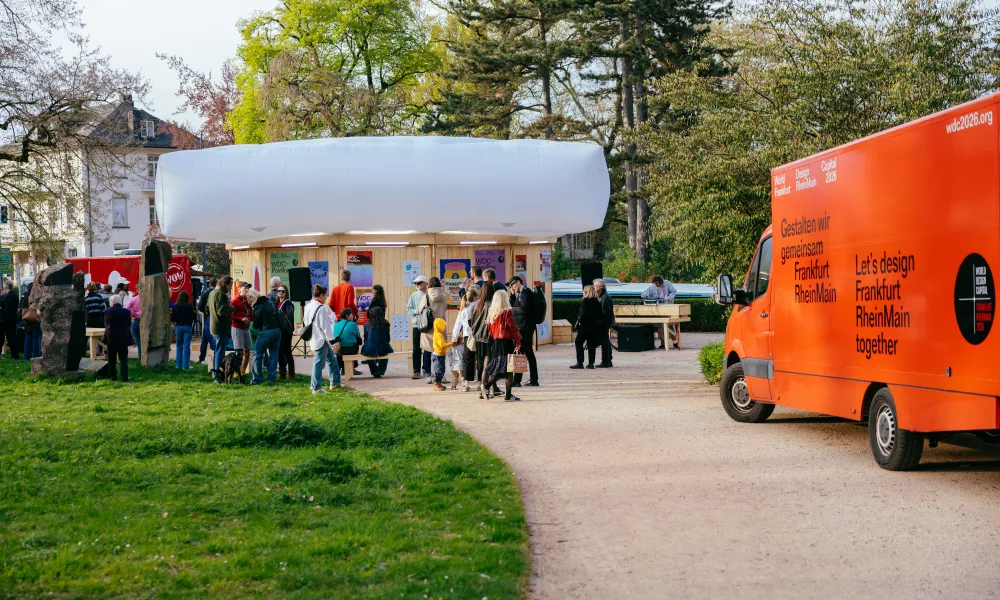
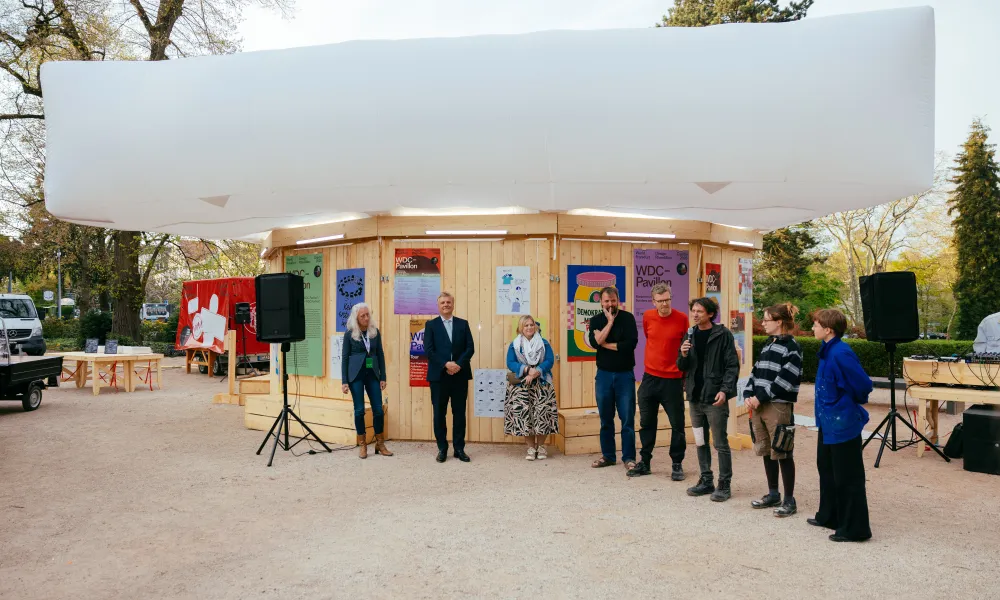
A space that travels, transforms and only becomes complete through its visitors: from April, World Design Capital Frankfurt RheinMain 2026 will be sending its mobile WDC Pavilion on a tour. Until September, the striking structure will travel across the region as a connecting element, stopping in six towns and cities. In line with the WDC guiding theme Design for Democracy. Atmospheres for a better life, the transdisciplinary architecture network Constructlab has developed a pavilion that brings people together and provides space for collaborative design. The aim is to bring design directly into the public realm and make it tangible as an anchor for community, sustainability and democratic participation. The tour opens with its first stop in Bad Homburg, where the WDC Pavilion will be located in the Kurhaus gardens from 15 to 26 April 2026.
The WDC Pavilion is not a conventional building, but a living laboratory for design that goes where life happens: into the heart of the city. The programme is aimed at the entire urban community. On weekday mornings, school classes and youth groups use the space to discover design as a tool for shaping their own environments. In the afternoons, evenings and at weekends the pavilion becomes a stage for local initiatives, workshops, performances or spontaneous gatherings.
An Architecture of Openness: “Mobile Agora” by Constructlab
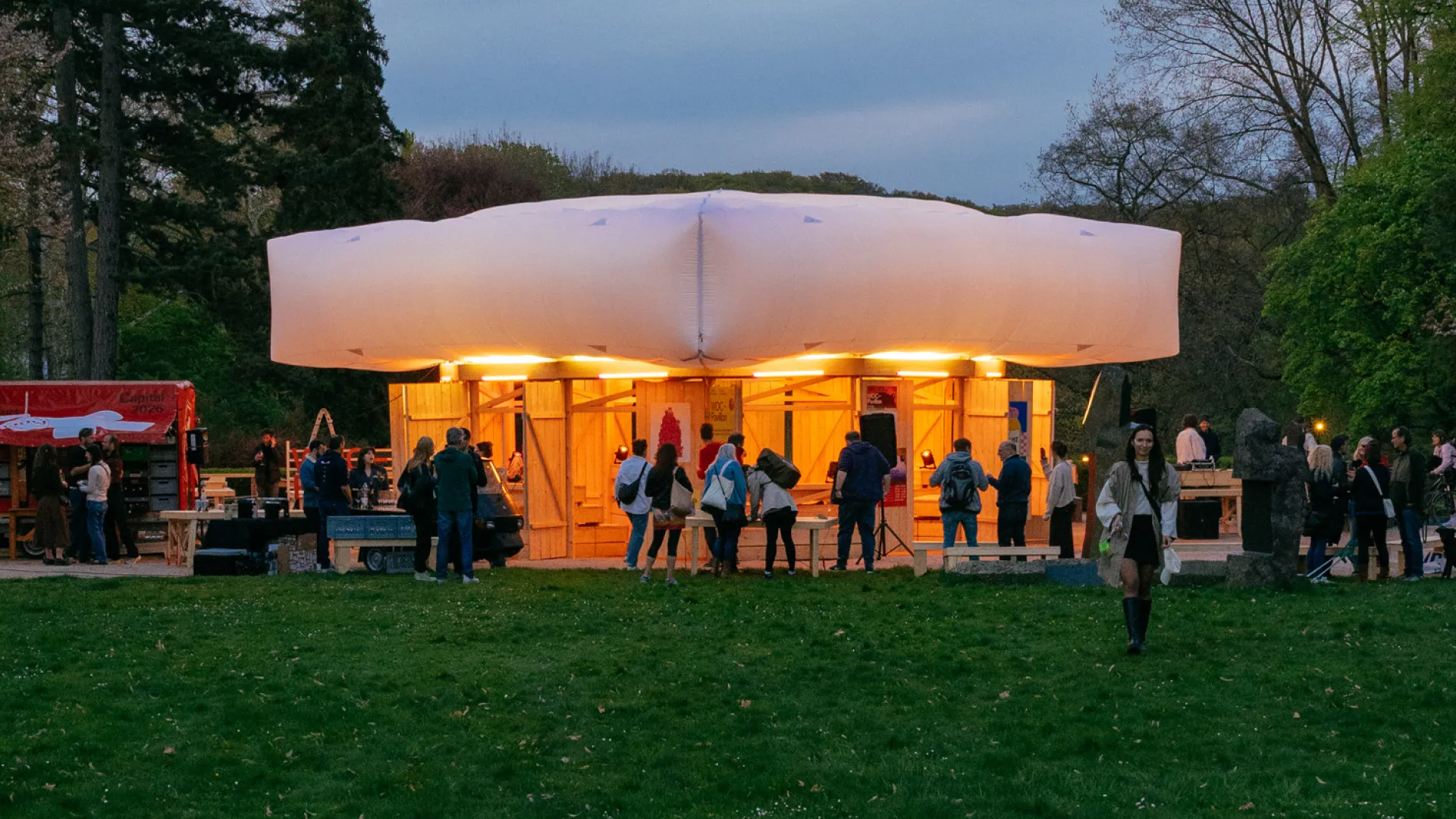
The pavilion was developed in close collaboration with the international architecture network Constructlab. Deliberately departing from conventional building typologies, the structure is conceived as a “mobile agora” – a place of exchange, inspired by everyday situations and typologies such as workshops, kitchens or gatherings – places where people come together and take action. At the core of the structure is a timber dodecagon with a diameter of 8.50 metres. A defining feature is its architectural openness: the pavilion has no fixed front or back, nor any rigid hierarchies. It is conceived as an open circle rather than a closed box. A distinctive inflatable roof with a span of 10 by 10 metres creates a strong visual presence and an overall height of 4.9 metres, while remaining light and inviting — a kind of “fair-weather cloud” that generates atmosphere without enclosing the space. Flexible seating modules, tables and stage elements can be continually rearranged to suit specific local requirements, all sheltered beneath the pavilion’s characteristic cloud-like structure.
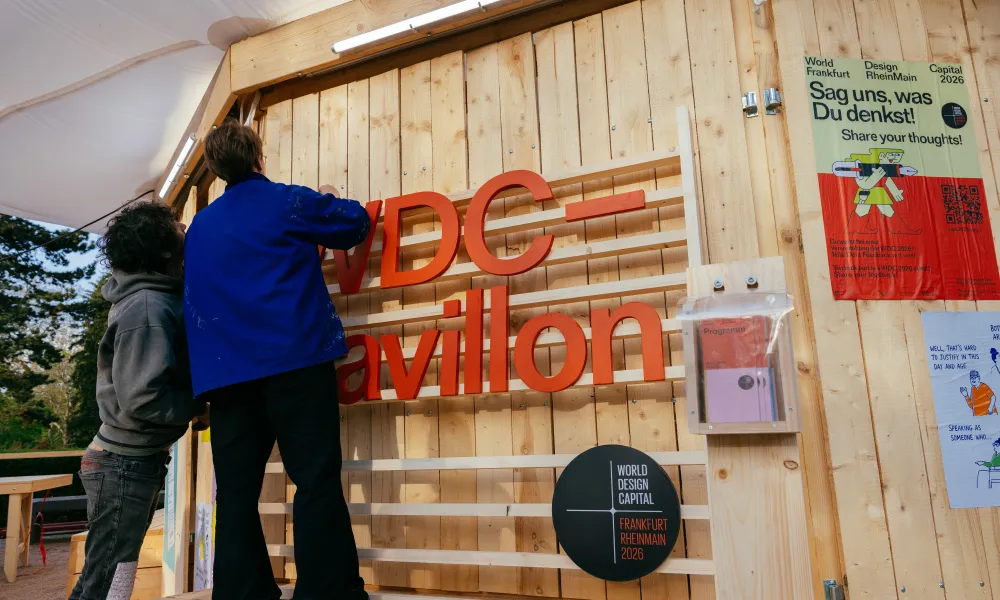
“The pavilion is not a finished object, but an open system that invites use,” explains the Constructlab team. One element, for example, serves as a public billboard. It is constantly used by visitors, who create new layers of content, thereby making ongoing activities visible and inviting others to participate.
“The WDC Pavilion brings to life what design can mean as a social attitude – extending far beyond the object itself,” emphasises Carolina Rohman, managing director of WDC 2026. “Democratic coexistence becomes a lived experience: the pavilion is a place that demonstrates how design can strengthen our social fabric and act as a driver for change across the region.”
Connecting People – Connecting Cities
The programme for the pavilion is developed in collaboration with local initiatives, institutions and WDC partners. It combines fixed programme elements such as educational and outreach activities with open and community-driven formats that allow for spontaneous participation. Each stop is accompanied by a “residency”: members of the Constructlab network work on site, connect with local partners and use the pavilion as a temporary studio.
Overview of the 2026 Tour Stops:
- Bad Homburg: 15 to 26 April, lawn behind the Kurhaus
- Kelkheim: 6 to 17 May, in front of the Town Hall
- Offenbach: 27 May to 14 June, Aliceplatz
- Wiesbaden: 24 June to 12 July, Kochbrunnenplatz
- Rheingau (Rüdesheim): 19 to 30 August, grounds of Brömserburg
- Darmstadt: TBA, square in front of the Central Station
All programme events are open to the public and free of charge.
Kick-off: Bad Homburg:
The WDC Pavilion will celebrate the official launch of its regional tour on 15 April 2026 at 6.30 pm with a soft opening on the lawn behind the Kurhaus in Bad Homburg. There will be music, refreshments and drinks, and all residents are invited to explore the structure for the first time and gain an insight into the upcoming programme. A special highlight: Constructlab designers Patrick Hubmann and Helene Freytag will be present in person, marking the start their two-week residency in the pavilion. During its stay in Bad Homburg (15 to 26 April), the pavilion will be transformed into a vibrant hub of activity. The programme reflects the diversity of local and regional collaborations: for instance, the German Design Museum Foundation will offer specially designed workshops for schools, while the Sinclair-Haus Museum is hosting creative workshops linked to its exhibition Vogelperspektiven (bird’s-eye views). Social issues and exercise also play a role: Über den Tellerrand e. V. will present a film screening, Oberursel Mittendrin will invite visitors to a cycling tour followed by a talk, and the Bad Homburg Children’s Art School offers activities for young creative talents. The programme is rounded off by the artistic performance Hooked on a Book, staging the pavilion as a place of inspiration. Further details are available online:
https://wdc2026.org/de/frames/wdc-pavillon-in-bad-homburg
What remains?
The pavilion will continue to serve the region beyond the 2026 project year. The structure has been designed for long-term use and can be relocated, adapted and repurposed after 2026. Individual elements can be modified, repaired or integrated into new projects. “What ultimately remains is not only the structure itself, but what it sets in motion: through the residencies, something is left behind at each location – new collaborations, shared experiences, newly acquired skills. That is precisely our understanding of legacy,” says Carolina Romahn.