
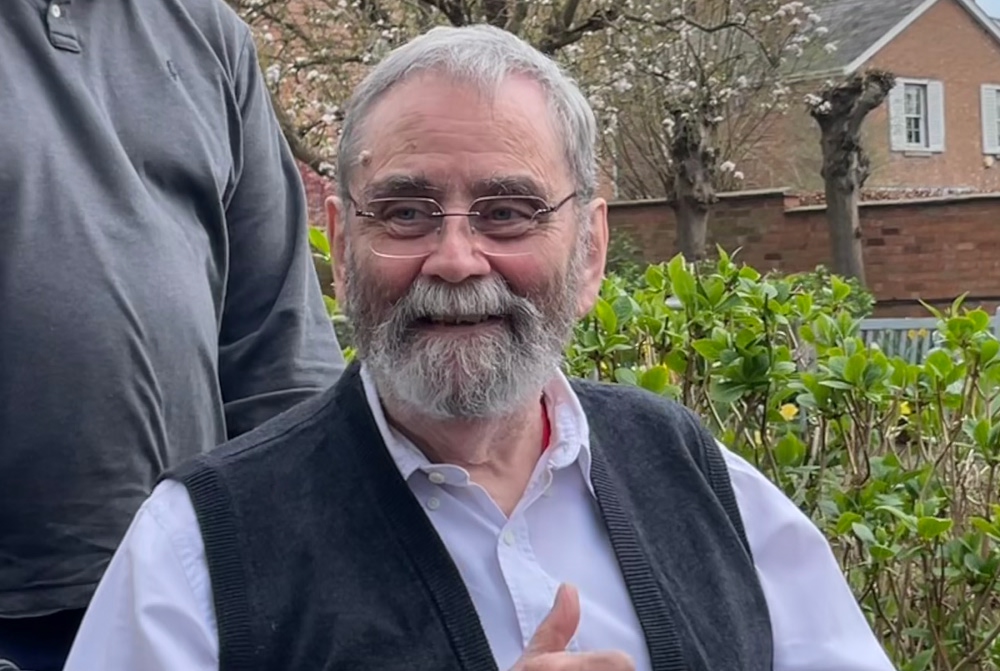
Royal Leamington Spa (United Kingdom) – Patrick Rylands, the British designer best known for creating iconic toys such as PlayPlax as well as the Bird and Fish bath toys, died peacefully on Thursday 11th December 2025 at the age of 83 after a short battle with vascular dementia. Having lived most of his life in Belsize Park, London, he moved to Royal Leamington Spa to live out his final years near his sister.
Rylands was a Royal Designer for Industry (RDI) and also the youngest recipient of the Duke of Edinburgh’s Prize for Elegant Design, now known as the Prince Philip Designers Prize. He was best known for his 30-year tenure as Chief Designer for Ambi Toys, where he championed the philosophy that toys should be mechanically simple, durable, and intrinsically playable. He consistently maintained a preference for non-electronic, physical toys, emphasising ‘learning through handling’ as he believed that physical interaction with objects supported cognitive development in early childhood.
Rylands’ work is held in the permanent collections of the V&A Museum of Childhood in London, and has previously been displayed at the Museum of Modern Art (MOMA) in New York as well as the 2012 Olympics held in London.
A lifetime in design
Having attended the Hull college of Art, Rylands went on to the Royal College of Art in London, graduating with an MA in ceramics in 1966. While still a student, he designed PlayPlax, an interlocking construction toy consisting of transparent colored squares, which remains a recognised example of 1960s British design and has sold over one million units.
In 1970, Rylands was awarded the Duke of Edinburgh’s Prize for Elegant Design (now the Prince Philip Designers Prize) for the range of toys he produced for Trendon, which included PlayPlax, LittleMen and Mosaic – making him the youngest ever recipient of this honour at the age of just 27. The award praised the ability of his abstract toys to encourage imaginative play, especially the designs’ ability to introduce children to concepts of form, balance, and structure.
In 1999, Rylands was elected as an RDI by the Royal Society of Arts, the highest accolade for designers in the United Kingdom. Many of the toys that he designed are recognisable by the use of ABS plastic, smooth radii, and a strict palette of primary colors—red, blue, yellow, and white—chosen for their visual clarity for infants.
Rylands is particularly known for his work at Dutch company Ambi Toys (formerly Europlastic), which he joined in 1976. During his time there, he was responsible for the design and development of the company’s core product line. Notable designs from this period include the innovative Bath Duck toy, the Duck Family (which had mini ducks that fit into the larger duck), Cool Cat, Rocky Jocky and more. Many of these toys are considered valuable by toy aficionados.
An avid collector
In later years, Rylands was known for having amassed an impressive archive of toys that celebrated the history of play. His collection was diverse and deeply personal to his taste, being driven by his enjoyment or appreciation for an item rather than any consideration of financial value. As a result, his archive included what is assumed to be the UK’s best Victorian marble collection, as well as 1930s American radios, a number of automatons, many created by Paul Spooner, a “Polyphon” – a 7-foot-high floor-standing music box – and many other pieces.
Family information
Rylands was born in Hull in 1943 to Ada Mary Rylands and Leo Hugh Cairns Rylands. He married his late wife Ljiljana Rylands (previously Momcilovic) in Bradford in July 1966 in the Serbian Orthodox church. The couple met while they were both students at the Royal College of Art, after which she became an accomplished illustrator who worked with authors including Roger McGough.
He is survived by his sister Josephine (Jo) Young, who says, “Patrick influenced my life greatly and was always there to support and guide me. He was the reason that I went to art college, following his lead, and then joining him in London. Of my four older brothers, Patrick was the closest to me, and I will miss him immensely.”


