
Image credit: Planisfero Politico by Giuditta Vendrame (2017)
How Singapore is putting a value on design
Championing design as a driver of economic growth is one thing. Demonstrating its value to businesses is another. As Singapore’s national agency for design, WDO Promotional Member DesignSingapore Council decided to tackle that challenge with evidence.
Its 2025 study, Measuring the Value of Design in Singapore, offers a closer look at how design contributes to business performance and wider societal outcomes. We spoke with Lynn Khoo, Deputy Executive Director of DesignSingapore Council, about the challenge of measuring design’s impact, what the research reveals about its strategic value and how the findings could influence business investment in design, both in Singapore and internationally.
What prompted DesignSingapore Council to undertake this study?
Design has the potential to unlock huge impact but many organizations, businesses and even designers themselves have shared that it is a struggle to track and measure design. This is why DesignSingapore Council commissioned this study, produced by Desire Lines and Oxford Economics, to come up with a data-backed framework that measures the impact and value that design brings to an organization.
One of the challenges identified in the study is that design’s contribution can often be difficult to isolate or articulate. How did you determine what should be measured?
The report was a 16-month undertaking, using a mixture of primary and secondary research. It surveyed 270 Singapore-based organizations across eight key sectors and a selection of public institutions, capturing how they use design and their reported impact on profitability and performance, as well as social and environmental goals.
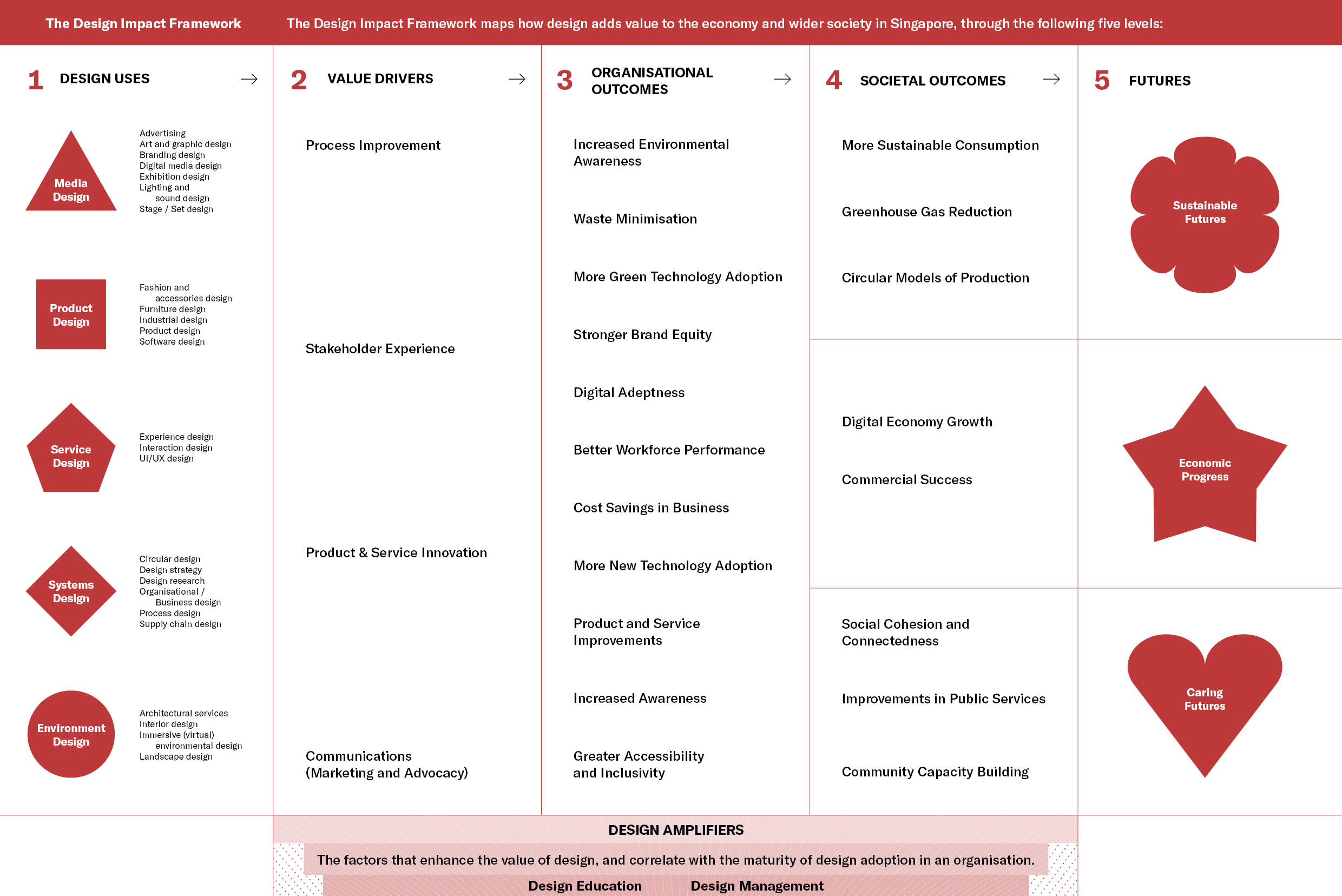
Working on the report revealed how little quantifiable data exists on design’s impact in Singapore. This showed the need for a framework that helps organizations identify what to measure and build a stronger evidence base over time. To create the framework, the report took an additional step of assembling a Methodology Advisory Panel (MAP) to provide strategic and technical advice on refining our framework and methodology. Now, we can now map out how design adds value to an organization and wider society, by going through five steps.
Design uses
How organizations typically use design
Value drivers
The outputs through which design adds value inside an organization
Organizational outcomes
What a design-using organization gains
Wider societal impacts
How organizational value becomes societal value
Futures
The national outcomes design influences
The study found that 90% of surveyed organizations experienced positive outcomes from using design. What finding surprised you most about design’s role in business?
What stood out was how 41% of organisations that have design champions in leadership positions reported a very high impact on profitability compared with just 17% of those without one. This reinforces that design adoption needs support and commitment from the top to translate into meaningful business outcomes.
At the heart of the study is the Design Impact Framework, developed to help designers and business leaders speak a shared language about value. Why do you think it’s important to connect design with the metrics businesses already use?
Businesses make decisions based on value, using metrics such as profitability, revenue growth, productivity, cost savings and return on investment. Design needs a concrete way to demonstrate how it contributes to these outcomes in a language business leaders already understand.
The framework helps make design’s value more tangible and actionable. Good design can help businesses identify new market opportunities, improve customer experience, build brand differentiation, increase operational efficiency and ultimately strengthen their bottom line. When we can connect design interventions to these business outcomes, design becomes a strategic business investment.
The study includes case studies from Singapore-based organizations where design contributed to outcomes such as revenue and operational efficiency. Can you share an example of design investment translating into tangible business value?
A good example is the fashion label GINLEE, which reimagined its business model through the Council’s Good Design Research Grant. With a new machine developed, the brand focused on on-demand production and customization, reducing waste while creating new retail experience. This attracted new customer segments, including younger customers and more male shoppers, contributing to 10% of GINLEE’s total revenue in 2024.
What do you hope changes when business leaders have stronger evidence of design’s impact? Could better measurement change how businesses involve designers?
When leaders can see how design contributes to revenue, growth, competitiveness and efficiency, they are more likely to invest in it. But the commitment must be there to give design the time and mandate for it to demonstrate its potential to drive business growth and transformation.
Beyond using designers to develop solutions, involve them earlier. What the report also revealed is that design delivers greater impact when embedded upstream and integrated strategically across business functions, with design-mature organizations reporting performance improvements of up to 48%.
What needs to happen for measuring design impact to become standard business practice internationally?
The more we can demonstrate design’s impact across different industries and markets, the stronger the case we make for design adoption everywhere. Design is a strategic capability to shape better outcomes – for businesses, people and the environment.
I hope the report resonates and encourages organizations all over the world to test the framework and share their findings with us. In the longer term, developing shared indicators such as those used for ESG reporting could help establish design impact measurement as standard business practice.

Lynn Khoo is Deputy Executive Director of DesignSingapore Council, Singapore’s national agency for design. Bringing experience across business strategy, technology and economic development, she works to strengthen Singapore’s design ecosystem and advance design as a driver of innovation, business growth and societal impact. Prior to joining DesignSingapore Council, she held leadership roles at the Singapore Economic Development Board and Udemy, following nearly a decade working in Silicon Valley.


